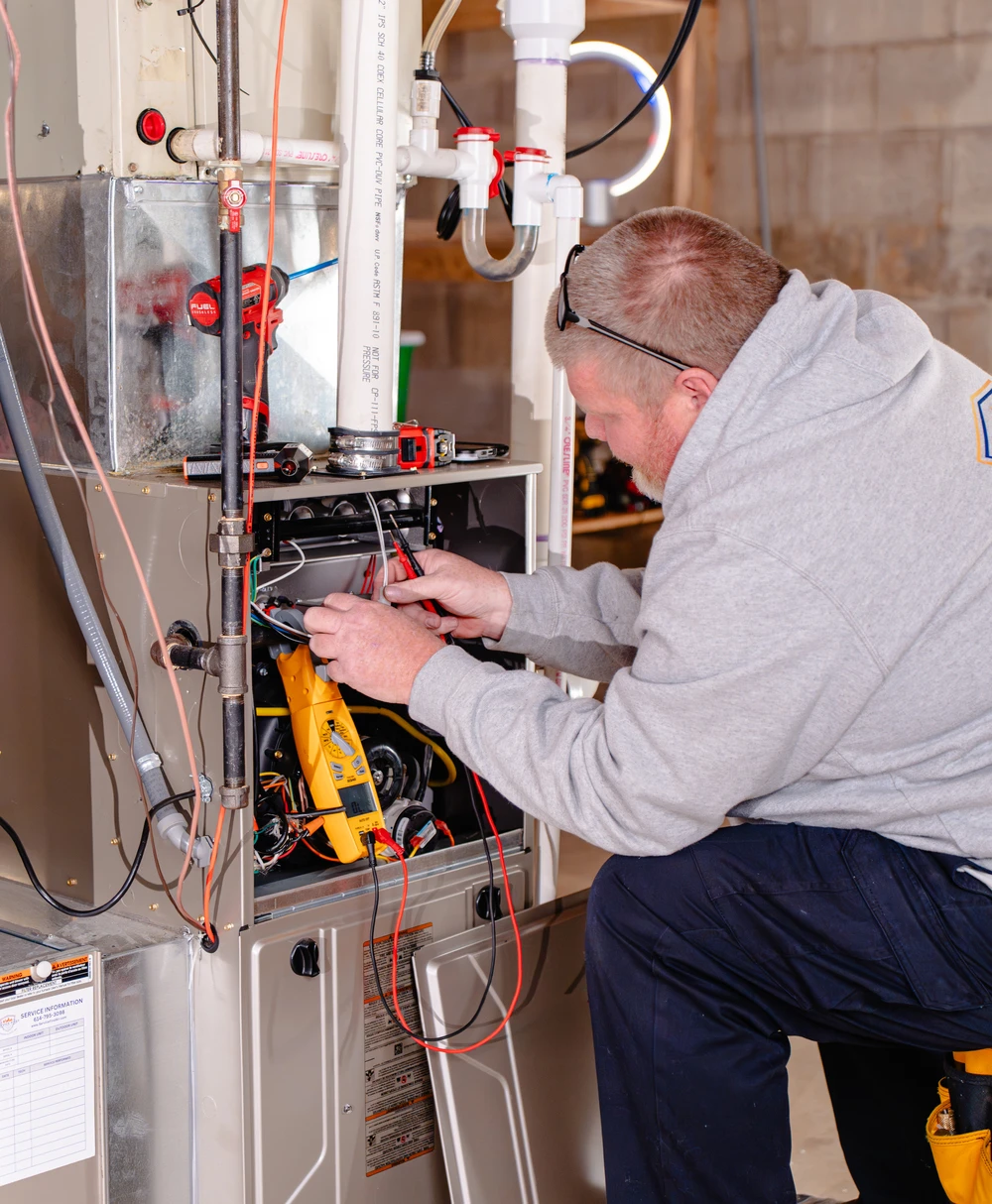
If you're wondering how much a new furnace costs, you're not alone — it's one of the most common questions I get from homeowners across Central Ohio. The short answer: most furnace replacements in Ohio range from $4,500 to $12,000+ depending on the equipment, your home's setup, and the work involved. But that range isn't random — and understanding what drives the price can help you make a smarter, more confident decision when the time comes.
I've been installing and replacing furnaces in Central Ohio for years, and I can tell you: the price you see online is rarely the price you pay — and there are good reasons for that. Let me break it all down for you.
Key Takeaways
- New furnace cost in Ohio typically ranges from $4,500–$12,000+ depending on size, efficiency, and installation complexity.
- Efficiency rating (80% vs 90%+ AFUE), ductwork condition, and venting setup are the biggest pricing factors beyond equipment cost.
- The cheapest quote isn't always the best — what's included in the installation matters more than the bottom line number.
- Service First includes a digital thermostat, carbon monoxide detector, and a 1-year Advantage Plan with every furnace replacement.
What Is the Average Cost to Replace a Furnace?
The average furnace replacement cost in Ohio falls between $4,500 and $12,000+, and where you land in that range depends on your home's specific needs. I always tell homeowners that there's no "one-size-fits-all" price — your neighbor's quote and yours could look very different even if you live on the same street.
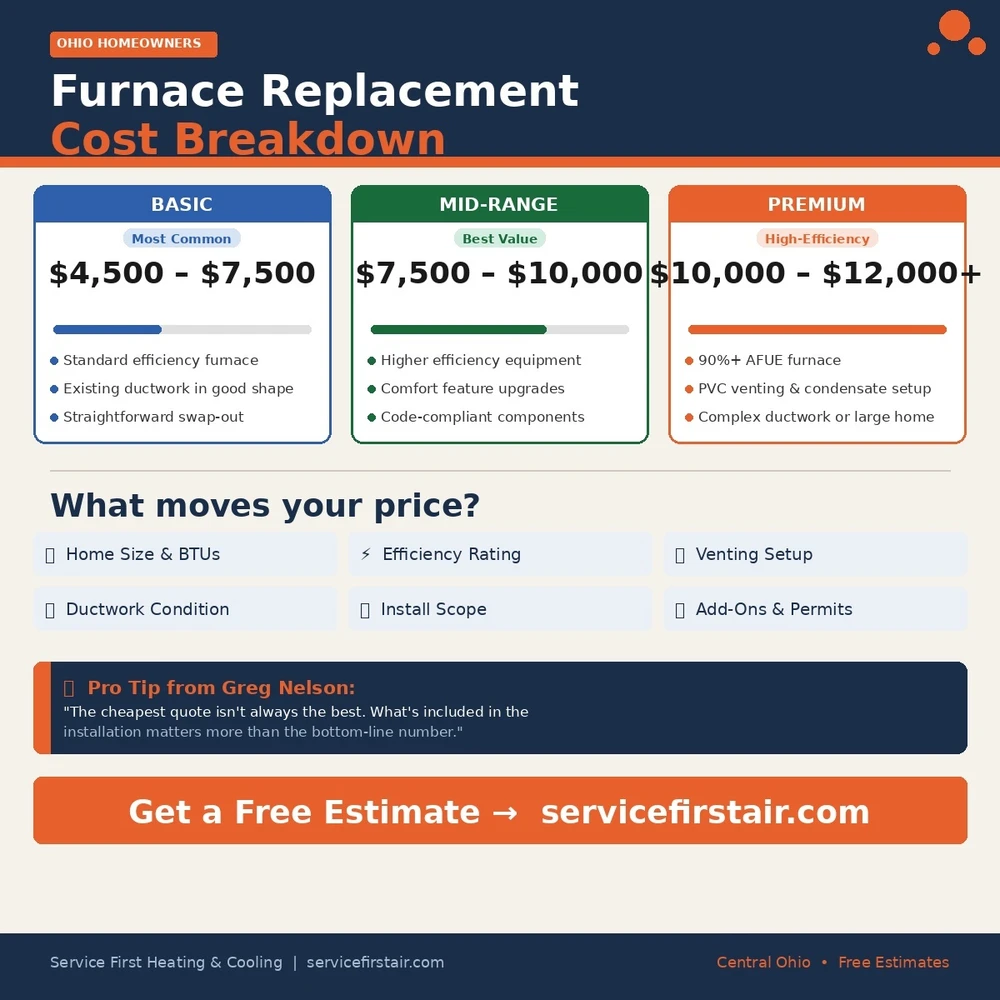
Here's a general breakdown of what you can expect:
Basic Replacement
Standard efficiency, existing ductwork & gas line in good shape can range from $4,500–$7,500
Mid-Range Upgrade
Higher efficiency, more comfort features, updated components can range from $7,500–$10,000
High-Efficiency / Complex
90%+ AFUE furnace, venting upgrades, condensate setup, complex install can range from $10,000–$12,000+
One important thing I want you to understand: online pricing tools are almost always missing the real-world installation costs that make your system safe, efficient, and long-lasting. They show the equipment price — not the whole picture.
"I always tell homeowners: the furnace itself is only part of what you're paying for. The real value is in the installation — the venting, the sizing, the safety checks. That's what separates a system that lasts 20 years from one that gives you problems in year three." — Greg Nelson, Service First Heating & Cooling
What Factors Affect Furnace Replacement Cost?
Seven key factors drive your gas furnace replacement cost: furnace size (BTU output), efficiency rating, your home's venting setup, ductwork condition, what's included in the installation, comfort add-ons, and local permit requirements. Each one can meaningfully shift your final price — sometimes by thousands of dollars.
1. Furnace Size (BTU Output)
Furnaces are sized based on your home's heating load — measured in BTUs (British Thermal Units). This isn't just a technical formality. I've walked into homes where the previous contractor installed an oversized furnace, and the homeowner was dealing with short-cycling, uneven temps, and a unit that was already half-worn-out.
A furnace that's too small struggles to keep up and runs constantly. A furnace that's too large short-cycles, creates humidity issues, and wears out prematurely. Proper sizing is one of the most important things we do — and it's one reason why quotes vary so much between homes.
2. Efficiency Rating: 80% vs. 90%+ AFUE
AFUE (Annual Fuel Utilization Efficiency) tells you how much of your fuel dollar actually becomes heat. An 80% furnace converts 80 cents of every gas dollar into usable heat. A 90%+ high-efficiency furnace converts 90+ cents — and the difference shows up on your monthly utility bill.
The trade-off: 80% furnaces use metal venting (often into a chimney) and typically cost less upfront. High-efficiency units use PVC intake and exhaust pipes, require a condensate drain, and cost more upfront — but can qualify for utility rebates and lower your heating bills long-term. According to Carrier's furnace cost guide, efficiency upgrades are one of the top factors driving new furnace costs nationwide.
3. Your Home's Venting Setup
This is the one that surprises homeowners most. Venting changes can add significant cost to a furnace replacement — especially in older Central Ohio homes. If you're switching from an 80% to a 90%+ furnace, you're also changing from metal venting to PVC, which means new pipes, new penetrations, and possibly rerouting.
Older homes with masonry chimneys sometimes need a stainless chimney liner added — that alone can add $800–$2,000+ to the project. This is exactly why I never trust an online quote, and why I insist on an in-home visit before giving a final price.
4. Ductwork Condition and Airflow Issues
A furnace replacement isn't always a plug-and-play swap. If your existing ductwork is undersized, leaking, crushed, or poorly designed, the new furnace will inherit those problems — and you'll still have cold rooms, noisy airflow, and a system that runs harder than it should.
We do airflow and static pressure checks as part of our process. If there are issues, we'll tell you — and we'll quote the duct repairs needed to make your new system actually perform. That might mean sealing, adding return air, or adjusting transitions. It's extra work, but it's the right way to do the job.
5. What's Included in the Installation
This is a big one — and it's the source of a lot of confusion when homeowners are comparing quotes. Two estimates might show very different numbers, but it's not always because of the equipment. It's often because of what's included (or left out) in the labor and installation scope.
A quality furnace installation from Service First includes:
- New gas flex line and sediment trap (drip leg)
- New shutoff valve if needed
- Electrical safety checks
- Proper venting connections and sealing
- Full system startup and performance testing
- Carbon monoxide safety check and combustion analysis
Cheap installs that skip these steps almost always cost more in the long run — through callbacks, safety issues, and early equipment failure.
6. Comfort Features and Optional Add-Ons
Some homeowners want more than just heat — and furnace replacement is often the ideal time to upgrade your whole system. Optional add-ons that can affect the final new furnace cost include smart thermostats, whole-home humidifiers, media air filters, UV air purification, and surge protection.
None of these are required. But if you've been dealing with dry air in the winter or allergy symptoms, a humidifier or air purification system added at install time is almost always more affordable than adding it later.
7. Permits, Code Requirements, and Safety Testing
A furnace is a gas appliance connected to your home's electrical system — which means safety isn't optional. A professional replacement includes permit requirements (which vary by jurisdiction in Central Ohio), carbon monoxide safety checks, combustion testing, and verification of proper clearances and venting.
If a contractor tells you they don't pull permits, that's a major red flag. It can void your equipment warranty, create problems when you sell your home, and — most importantly — put your family at risk.
What Should Be Included in a Furnace Replacement Estimate?
A professional furnace replacement estimate should clearly spell out the equipment model, efficiency rating, full scope of work, safety testing procedures, thermostat details, and what happens if additional repairs are needed. Vague quotes are a warning sign.
"A homeowner should never feel like they're guessing what they're paying for. If your quote doesn't explain the brand, the size, the efficiency rating, and what the installation includes — ask. And if the contractor can't explain it clearly, that tells you something." — Greg Nelson
Here's what should be in any solid estimate:
- Equipment brand, model, size, and AFUE rating
- Manufacturer warranty details
- Full scope of work (what's being removed, installed, tested)
- Venting and condensate/drain setup (if applicable)
- Thermostat — included or separate?
- Any additional repairs or upgrades needed and why
- Labor, timeline, cleanup, and haul-away of old equipment
What Questions Should I Ask Before Replacing My Furnace?
Before choosing a furnace or a contractor, ask yourself: How old is my current unit? Am I replacing because of a single repair or a pattern of problems? Do I want lower monthly bills or lower upfront cost? Do I plan to stay in this home long-term? These questions will steer you toward the right system.
Here are the questions I walk every homeowner through before we talk equipment:
- How old is your furnace? Most last 15–20 years with proper maintenance.
- Are you replacing because of one repair — or a pattern of failing parts?
- Do you have hot and cold rooms now? Let's fix the root cause, not just swap the box.
- Are you staying in this home 5–10 years? If so, efficiency upgrades usually pay off.
- Do you want better indoor air quality? Furnace install time is the best time to add humidification or filtration.
What Is the Biggest Mistake Homeowners Make When Comparing Furnace Quotes?
The biggest mistake is choosing the lowest number without understanding what's missing. A low furnace replacement quote often means corners were cut — on venting, safety testing, ductwork, or proper sizing. The furnace is only as good as the installation behind it.
I've seen it happen plenty of times: a homeowner goes with the cheapest bid, and six months later they're calling us because the system is short-cycling, there's a CO concern, or their bills are through the roof. At that point, fixing the problems often costs more than the savings were worth.
According to HomeGuide's furnace pricing data, installation quality and labor are major drivers of long-term satisfaction with any furnace replacement — regardless of brand.
When comparing quotes, ask each contractor to walk you through what their price includes. If they can't — or won't — that's your answer.
What's Included When You Replace Your Furnace With Service First?
When you replace your furnace with Service First Heating & Cooling, you get more than just new equipment — every installation includes a digital thermostat, a carbon monoxide detector, manufacturer warranty coverage, and a 1-year complimentary Service First Advantage Plan.
We serve Canal Winchester and the surrounding Central Ohio area, and we work with a number of trusted equipment brands. If you're local and want to learn more about our Canal Winchester furnace replacement services, we'd love to walk you through your options.
"We include the carbon monoxide detector and thermostat because it's the right thing to do. A gas furnace in your home is a safety appliance first. We want every customer to sleep soundly knowing their family is protected — not just that they got a new box in the basement." — Greg Nelson
Frequently Asked Questions About Furnace Replacement Cost
How long does a furnace last before it needs to be replaced?
Most furnaces last between 15 and 20 years with regular maintenance. If yours is older than 15 years and requires frequent repairs, replacement is likely the smarter financial decision.
Is it worth getting a high-efficiency furnace?
For most Central Ohio homeowners planning to stay in their home 5+ years, a 90%+ AFUE furnace is worth the upfront investment. You'll typically see lower monthly gas bills and may qualify for utility rebates. See Carrier's new furnace cost guide for more on efficiency comparisons.
What size furnace do I need for my Ohio home?
Furnace sizing depends on your home's square footage, insulation, ceiling heights, window area, and local climate. A proper Manual J heat load calculation is the only reliable way to determine correct sizing — not a rule-of-thumb estimate.
How long does a furnace installation take?
Most standard furnace replacements take 4–8 hours. More complex installations — those requiring venting upgrades, ductwork changes, or condensate drain setup — may take a full day. We'll give you a realistic timeline before we start.
Should I repair or replace my furnace?
If your furnace is under 10 years old and the repair cost is less than 50% of a replacement, repair often makes sense. If it's 15+ years old, repairs are stacking up, or the unit is unsafe, replacement is almost always the smarter long-term investment.
Ready to Get an Honest Furnace Replacement Quote?
Understanding how much a new furnace costs comes down to knowing what drives the price: equipment size, efficiency rating, your home's venting setup, ductwork condition, what's truly included in the installation, and your local permit requirements. In Central Ohio, most homeowners should plan for $4,500–$12,000+ — and the difference is almost always in the details.
The goal isn't to find the cheapest quote. It's to find the contractor who will do the job right — and give you a warm, safe, efficient home for the next 15–20 years. At Service First Heating & Cooling, that's exactly what we're here to do.
Get Your Honest Furnace Replacement Estimate
If your furnace is failing, noisy, or costing you more every winter, we're here to help — no pressure, no guesswork. Service First Heating & Cooling serves Canal Winchester and the surrounding Central Ohio area.
📞 Call us today or visit servicefirstair.com to request an estimate online.